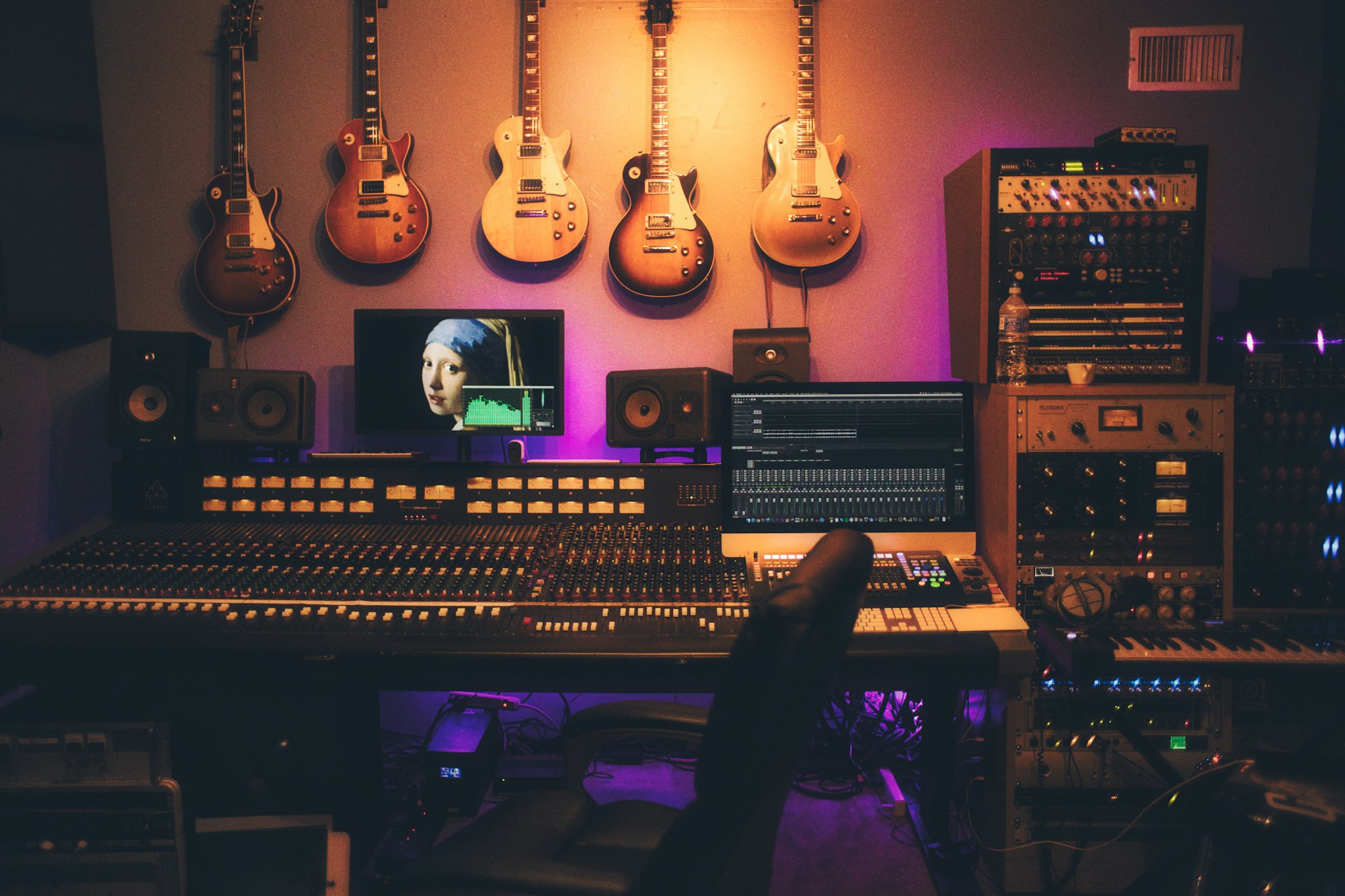
A home studio is best for writing, practice, voice work and low-pressure experiments, while a professional studio is best when you need a treated room, better acoustics and an engineer's ears for a final recording. Most creators end up using both: they build ideas at home and book studio time for the parts where quality matters most.
What actually makes a recording sound professional
People often think expensive microphones create a professional sound. In practice, four things matter more: the room, the performance, the microphone placement and the engineer's decisions.
A good room controls reflections. A good performance means the take is right before any processing. Placement means the microphone is in the right spot for the source. An experienced engineer ties these together quickly. A studio sells you these four things as a package, while a home setup makes you responsible for each of them.
When a home studio is the right choice
A home setup makes sense when:
- You record often and need to work on your own schedule.
- You are writing, sketching beats, practicing or recording demos.
- Your content is voice-based and a small treated corner is enough.
- You want to learn recording and mixing by doing it daily.
What a basic home setup needs
- A computer and recording software.
- An audio interface and one good all-round microphone.
- Closed-back headphones for recording and monitor speakers or reference headphones for mixing.
- Basic acoustic treatment: absorbent panels, blankets, rugs or bookshelves to tame reflections.
Be honest about your room. An untreated bedroom with bare walls will color every recording. Small improvements in treatment often beat upgrading gear.
When a professional studio is worth it
A studio is the better choice when:
- You are recording live instruments, vocals or multiple performers at once.
- You need isolation between sources, such as a vocalist and a guitar amp.
- You want a second set of experienced ears while you perform.
- The recording is a release, a client project or an important pitch.
- Your home environment is noisy or shared.
A studio also removes technical anxiety. Instead of troubleshooting a driver issue, you focus on performing. For many artists, that mental freedom improves the take more than any gear upgrade.
At Musitechnic in Montreal, the recording studio and podcast room are part of a campus where students in our in-person audio production programs also work in labs. If you need a specific room or equipment, ask us directly what is available.
Cost drivers to think about
We do not publish prices in this article, but here is how to think about the economics.
Home studio cost drivers: gear purchases, treatment, software, a computer powerful enough for your sessions, and your own time spent learning and troubleshooting.
Professional studio cost drivers: hourly or daily booking, engineer time if included, and any extra mixing or mastering you add afterward.
The smart question is not "which is cheaper?" but "where does each hour of my money change the result the most?" A one-day studio session for lead vocals can lift a whole project, while a home setup can handle overdubs, ideas and rough mixes.
A hybrid workflow that works
Many working producers split the process:
- Write and demo at home. Capture ideas freely and refine arrangements.
- Pre-produce. Make tempo, key and structure decisions before booking time, so studio hours go to performance rather than decisions.
- Record key parts in the studio. Vocals, live drums or any instrument that benefits from a treated room.
- Edit and mix at home or in a lab. Use headphones and reference tracks, and get a fresh listen from someone else.
Preparation is what saves money in a studio. Arrive with a clear plan, rehearsed parts and organized files. For more on how to behave and prepare, see our guide to studio etiquette and booking.
Studio residency as a middle path
If you want regular access without building a full room yourself, a studio residency can offer structured time in a professional environment. Ask Musitechnic how the studio residency works and whether it fits your project.
How to decide in five minutes
Ask yourself:
- Is my room quiet and acoustically controlled?
- Is this recording the final version or a draft?
- Do I need other people in the room?
- Can I judge the result accurately on my own?
- Do I have time to learn the tools, or do I need results now?
If most answers point to "draft, solo, learning," stay home. If they point to "final, group, deadline," book a studio.
Build your creative business, not just your sound
Where you record is one decision in a larger creative business. The Unica Creator Business Hub is a partnership for creators, artists, social media influencers and young startups. You can join as a referral partner (direct referrals only), and Unica incubation through Unica OS is included with your full-time program, for 6 to 12 months online or 12 to 20 months on campus. The 90-day open pilot is for 20 businesses. Incubation has no cash value and is not transferable.
Want to grow with us? Join the Creator Business Hub partnership.
FAQ
Can I get a professional sound at home?
Yes, for many voice-based projects, with a quiet treated space, good mic technique and careful editing. Complex multi-performer sessions are harder to do well at home.
What should I record at home before booking a studio?
Demos, rough arrangements and rehearsals. Arriving prepared lets you use studio hours for the best possible performance.
Is acoustic treatment more important than a better microphone?
Often, yes. A good microphone in a bad room captures the bad room. Improving reflections usually gives a bigger jump than upgrading the microphone.
Do I need an engineer if I book a studio?
Not always, but one is valuable if you want to focus on performing. Ask in advance what is included in a booking.